Showing posts with label private. Show all posts

Buckminster Knows 038


I'm in a bit of a hurry today, so here's a building which needs no explanation. The Lingotto Fiat factory in Torino (1923) by Giacomo Mattè-Trucco (1869-1934).

[image credits here and here]  

Buckminster Knows 021


The Palazzo Spada of 1540 in Rome, originally built by Bartolomeo Baromini, was purchased by Cardinal Spada who commisioned the Baroque master Francesco Borromini to modify it for him.
It was Borromini who created the famous trompe l'oeil in the arcaded courtyard. Through gradually diminishing the columns flanking the entrance, the perspective is dramatized. A feature also used by Bernini in his Scala Regia.

pictures found here and here 

Buckminster Knows 017


Caffé Pedrocchi by Giuseppe Jappelli ( 1783-1852). Striking and bizarre juxtaposition of a venetian Gothic wing (1837-42) and a Greek Doric wing (1826-31). I'm not sure if it's in Venturi's 'contradiction and complexity' but it ought to be...

pictures here and here

Buckminster Knows 015


Domus Aurea (64-68 AD), begun by Nero after the great fire of 64 AD, it consists of a series of pavillions and a long wing comprising living and reception rooms, all set in a marvelous piece of nature. 
The 'Golden House' also contains the famous 'octagonal room', roofed by a concrete dome and open to all sides thus connecting with the surrounding smaller rooms and with the garden. 
This concept of interior space was used here for the first time and became later a substantial inspiration for renaissance architects and artists. 
images here, here and here

Buckminster Knows 009


The Palazzo Barberini is the most important domestic building of the Baroque period. With contributions by all the leading Baroque architects: Gian Lorenzo Bernini (1598-1680), Francesco Borromini (1599-1667), Carlo Maderno (1556-1629), Pietro da Cortona (1596-1669)... The building differs from other town palaces in its gardens and H-shaped plan, making it almost look like a villa. Novel features are the square staircase, ground-floor atrium (resembling a stoa) and the now destroyed transversed sala, an element implemented by Bernini (to whom the Palazzo is normally attributed) which would later become frequent in his architectural repertoire.  

pictures found at usc.edu and at euexco.com

Buckminster Knows 004


Casa Elettrica (1930) by rationalists Luigi Figini(1903-1984) and Gino Pollini(1903-1991), everything you need to know and see you can find here. I hope you will notice a couple of modernists "borrowed" ideas from this project.

Buckminster Knows 003


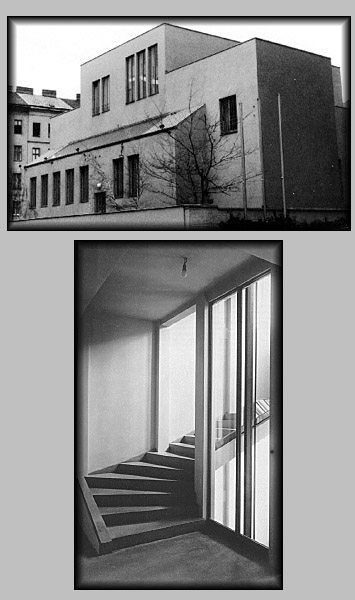
Paul Engelmann and the philosopher Ludwig Wittgenstein (1889- 1951) designed and built this villa from 1926 to 1928 for Margarethe Stonborough-Wittgenstein, the philosopher's sister. In its austerity and simplicity, the structure reflects the logical clarity of Wittgenstein's thinking. Fourty years ago, the government of Bulgaria purchased the building. After careful restoration, the building now houses the Bulgarian Cultural Institute. This is the only building Wittgenstein ever built. Absolute perfection.
pictures here and here and here